
The AI Opportunity of 2026: From Chatbots to Autonomous "Agentic" Enterprises
2026 is the year of the AI Agent
The gold rush of 2024 and the experimental pilots of 2025 have converged into a singular, undeniable reality:
2026 is the year of the AI Agent. We have officially moved past the "How do I use ChatGPT?" phase. Today, the conversation has shifted from individual tools to
Business Automation 2.0—a world where AI doesn't just answer questions; it executes workflows, manages supply chains, and operates as a "silicon workforce." For leaders, the "AI opportunity" is no longer about finding a use case; it’s about re-architecting the entire enterprise to be
AI-native.
1. The Rise of the "Agentic" Workforce: Beyond Generative AI
The most significant shift in early 2026 is the transition from Generative AI (which creates content) to Agentic AI (which takes action).
Unlike the chatbots of 2024, AI agents in 2026 are autonomous. They can interface with third-party services, monitor real-time data, and adjust strategies without human prompting. According to recent industry forecasts, nearly 80% of enterprise applications now feature embedded AI copilots, but the real winners are those moving toward "Agentic Platforms."
- Autonomous Workflows: Agents are now handling end-to-end processes in HR, finance, and IT. For example, an AI agent can identify a recruitment need, screen 500 resumes, schedule interviews, and draft offer letters—all while maintaining compliance with local labor laws.
- Collaborative Intelligence: We are seeing the emergence of "multi-agent systems" where different AI agents—specialized in different tasks—negotiate with one another to solve complex business problems.
2. Industry-Specific Clouds: The Death of "One-Size-Fits-All"
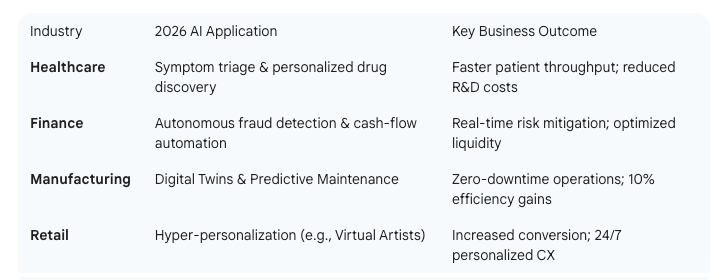
In 2026, the era of generic AI models is fading. Enterprises have realized that a model trained on the entire internet isn't as valuable as one trained on proprietary, industry-specific data.
Industry Cloud Platforms (ICPs) have become the new standard. Whether you are in healthcare, legal, or manufacturing, you are likely using a platform with pre-built data models and compliance configurations specific to your sector.
3. Physical AI: When Intelligence Hits the Real World
One of the most exciting "AI opportunities" of 2026 is the convergence of AI and Robotics. Intelligence is no longer confined to your screen.
- Autonomous Logistics: Companies like Amazon have surpassed
one million robots in their warehouses, coordinated by "DeepFleet" AI that improves travel efficiency by 10%.
- Smart Factories: BMW and other automotive giants now feature cars that literally "drive themselves" through the production line.
- The "Zero-Trust" Edge: AI is moving to the edge—processing data directly on sensors and machines to prevent outages before they happen, without the latency of the cloud.

4. The "Great Rebuild": Moving to an AI-Native Tech Stack
For the Senior Strategist, the biggest hurdle isn't the technology—it's the legacy process. 2026 is seeing a "Great Rebuild" where CIOs are moving away from traditional "Systems of Record" (like old CRMs) toward Autonomous Workflow Engines.
The Infrastructure Reckoning
While the cost of AI "tokens" has dropped nearly 300-fold in the last two years, enterprise usage has exploded. This has forced a shift from "cloud-first" to Strategic Hybrid Computing. * Cloud: Used for elastic, high-power training.
- On-Premises: Used for data sovereignty and consistent costs.
- Edge: Used for immediate, real-time action.
5. Navigating the Human Element: The "SuperWorker" and Ethics
As AI takes over repetitive tasks, the definition of a "valuable employee" has changed. We are seeing the rise of the "SuperWorker"—individuals who leverage AI to do the work of a five-person team.
The Skills Gap and Job Security
Goldman Sachs and other analysts warn of a "second wave" of AI-led layoffs in 2026, specifically targeting roles involving routine data processing. However, this is balanced by a massive hiring boom in:
- AI Governance & Ethics: Ensuring models aren't biased or "hallucinating."
- Data Sovereignty Specialists: Managing where and how proprietary data is stored.
- Human-Agent Orchestrators: Managers who specialize in leading hybrid teams of humans and AI agents.
Note on Ethics: In 2026, "Responsible AI" (RAI) isn't just a buzzword; it's a legal requirement. New "Autonomous Governance Modules" are being built into ERP systems to provide real-time audit trails for every decision an AI agent makes.
6. The 2026 Small Business Strategy: "Buy Over Build"
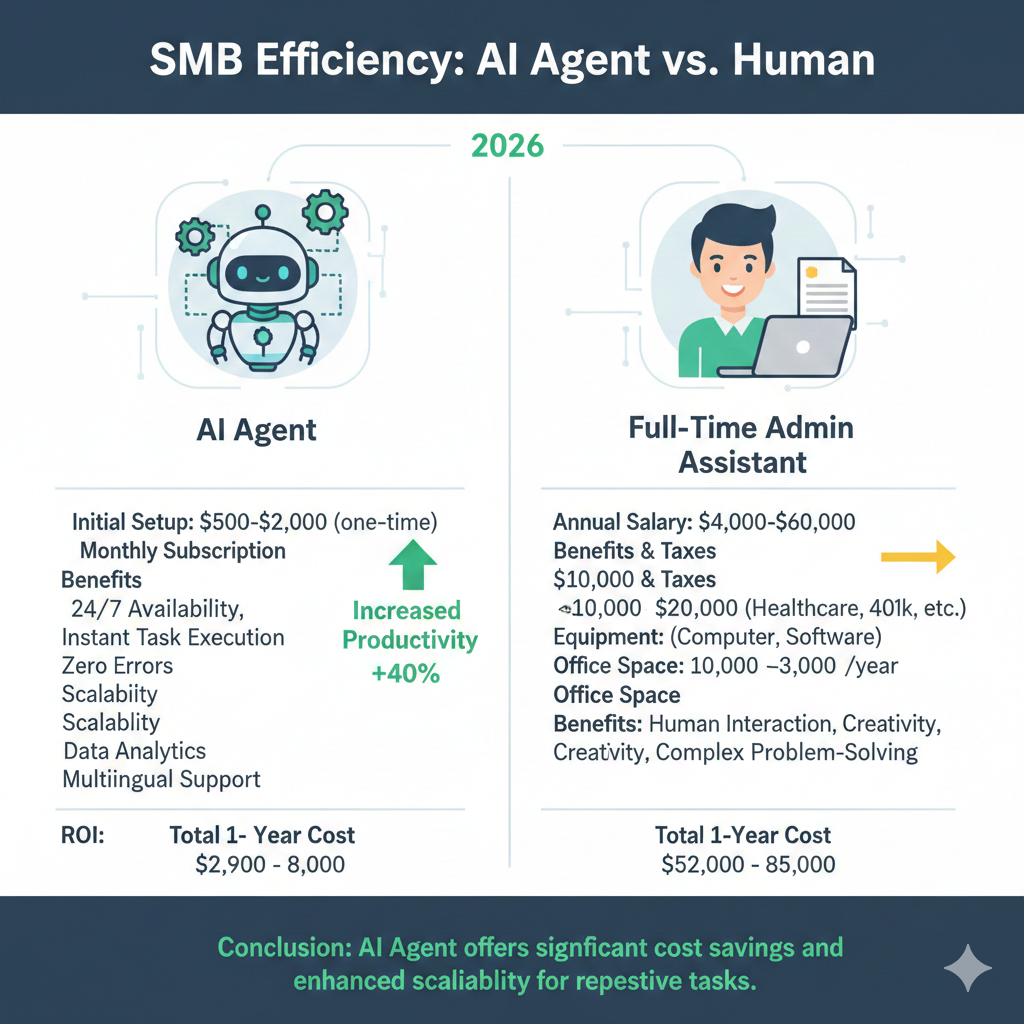
For small to mid-sized businesses, the "AI opportunity" has shifted. You no longer need a team of data scientists to compete.
- Off-the-Shelf Agents: SMEs are increasingly purchasing specialized AI agents rather than building them.
- Micro-Advisory: AI is democratizing high-end services, providing SMBs with the kind of financial forecasting and market analysis previously reserved for the Fortune 500.
Key Takeaways: Seizing the Opportunity
- Focus on Agency, Not Just Generative: Stop asking what AI can write and start asking what AI can do.
- Redesign, Don't Just Automate: Automating a broken process only makes it fail faster. Redesign your workflows to be "agent-native."
- Prioritize Data Quality: AI is only as good as the data it consumes. Invest in "Data Hygiene" before investing in expensive models.
- Governance is Competitive Advantage: Brands that can prove their AI is ethical, transparent, and secure will win customer trust in a crowded market.
Conclusion: The Window of Opportunity
The "Future of AI" is no longer a forecast—it is the operational reality of January 2026. The companies that are thriving today aren't the ones with the largest AI budgets, but the ones with the most strategic integration.
By moving from reactive tools to proactive agents, and from generic clouds to industry-specific intelligence, you aren't just "using AI"—you are building a resilient, scalable, and autonomous future.
What is your next step? * Are you ready to audit your current workflows for "Agentic" potential?
- Do you need to reassess your data infrastructure for the "Great Rebuild"?
The AI wave is here. It’s time to stop watching it from the shore and start riding it. Contact Me Today!
You can listen to coachAOG Excuse To Succeed Podcast Here. You will love it.
Thanks for reading this post today. Remember to comment below and share your thoughts.
Ayo Ogunrekun
PS:And remember what #coachAOG always say, make sure to "have an #ExcuseToSucceed."
Help Me Share The Love With Others & Comment Below
Latest 3 Posts